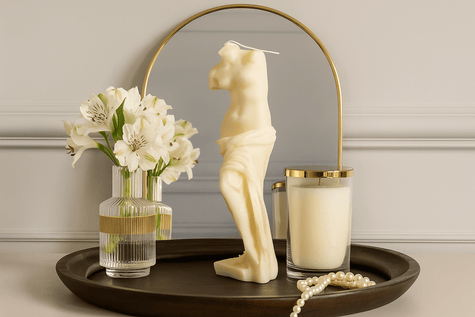
You don't need a professional studio. You need the right light, the right shots, and a clear understanding of what buyers need to see before they buy.
Your product is beautiful. Your photos might not be doing it justice.
This is one of the most common and most costly gaps in a handmade seller's business. You've spent hours perfecting your craft — the pour, the finish, the packaging — and then captured it with a blurry, poorly lit snapshot that undersells everything you've built.
Here's the truth: in an online store, your photos are your product. Shoppers cannot touch your candle, smell the fragrance, or hold the vessel in their hands. Every purchase decision they make is based entirely on what they see on their screen. If your photos don't communicate quality, care, and value — your listing won't convert, no matter how good the product actually is.
The good news is that great product photography for handmade goods does not require a professional camera, a studio setup, or an expensive photographer. It requires understanding a handful of principles and executing them consistently. This guide gives you both.
The Equipment You Actually Need
Before we talk about what to shoot, let's talk about what to shoot with — because most makers dramatically overcomplicate this.
Your smartphone is enough. Modern smartphone cameras, particularly anything released in the last three to four years, are capable of producing product images that perform exceptionally well on Etsy, Shopify, and social media. The camera is rarely the limiting factor. Light and composition are.
Here is the short equipment list that covers everything you need:
-
Smartphone or entry-level DSLR — shoot at the highest resolution your device allows
-
Tripod or phone stand — eliminates camera shake and keeps your framing consistent across a full shoot
-
Neutral backdrop — kraft paper, white card stock, linen fabric, or a wooden board. Buy a few options and test which works best with your product palette
-
Reflector — a piece of white foam board positioned opposite your light source to bounce light back and fill shadows. Costs less than $5 and makes a significant difference
That's it. Everything else is optional.
The Single Most Important Variable: Light
If you invest your attention in one place, make it light. Good light rescues mediocre composition. Bad light ruins perfect composition.
Natural window light is your best option. Position your shooting surface near a large window — ideally north-facing for consistent, diffused light that doesn't shift throughout the day. If your window is south or west-facing, shoot in the morning before direct sun hits it.
Never shoot in direct sunlight. It creates harsh shadows, blows out highlights, and gives your product an overexposed, flat appearance. Diffuse direct sun by taping a single layer of white tissue paper or a sheer curtain across the window — this turns harsh light into the soft, even glow that makes handmade products look expensive.
Avoid mixing light sources. Natural light and artificial light have different color temperatures, and mixing them creates an uneven, inconsistent color cast across your images. Shoot in natural light only, or artificial light only — never both at the same time.
If you shoot in artificial light, use a daylight-balanced LED panel or lightbox. These are available for under $50 and produce consistent results regardless of time of day or season.
The Six Shots Every Handmade Listing Needs
This is the framework. Every product in your catalog needs these six images before it's ready to list. Each shot does a specific job, and skipping any of them costs you conversion.
Shot 1: The Hero Shot
This is the first image a shopper sees — in search results, on your shop page, and at the top of your listing. It carries more weight than any other image in your catalog.
The hero shot should be:
- Clean and uncluttered — the product is the subject, not the backdrop
- Well-lit with no harsh shadows
- Centered with breathing room around the edges
- Shot straight-on or at a slight angle depending on your product's most flattering perspective
Test two or three hero compositions and compare their click-through rates over time. Small changes — angle, backdrop color, negative space — can meaningfully affect how often shoppers click into your listing.
Shot 2: The Detail Close-Up
This shot answers the question every handmade buyer is silently asking: what does it actually look like up close?
Move in tight. Fill the frame with texture, surface detail, material quality, or a specific design element that makes your product distinctive. For candles, this might be the frosted surface of a soy pour, the curl of a wick, or the translucency of a colored wax against light.
This is the shot that communicates craft. Don't skip it, and don't shoot it from too far away.
Shot 3: Multiple Angles
Show every side. Back, front, bottom, profile. Buyers who can't physically examine your product will mentally fill in the gaps — and what they imagine is almost always worse than reality.
Eliminating uncertainty is one of the most powerful things product photography can do. Every angle you show is one fewer reason for a buyer to hesitate.
Shot 4: Scale Reference
How big is it, really?
This is a question your listing description can answer in words, but a photo answers it faster, more intuitively, and more memorably. Shoot your product next to a hand, a common object, or a simple ruler.
For candles, a hand holding the vessel or a styled shot next to a recognizable object like a book or a coffee mug gives buyers instant size context. Incorrect size expectations are one of the most common drivers of returns and negative reviews. One scale shot prevents both.
Shot 5: The Packaging Shot
Show buyers exactly what will arrive at their door.
This shot builds trust in a way no other image can. It sets accurate expectations, reduces anxiety around gifting purchases, and communicates that your brand cares about the full experience — not just the product inside the box.
Include your box, tissue paper, any inserts or cards, and the sealed outer packaging. If you offer gift-ready packaging as an upgrade, photograph that separately and include it as an additional image with a clear label.
Shot 6: The Lifestyle Shot
This is the shot that sells the feeling, not the product.
A lifestyle image shows your product in context — on a bathroom shelf, on a bedside table, next to a steaming mug on a winter morning. It helps the buyer visualize the product in their own life, which is the mental step that precedes most purchase decisions.
Lifestyle shots require a bit more styling effort, but they consistently outperform plain product shots on social media and in paid advertising. If you have time to style and shoot only one extra image per product, make it the lifestyle shot.
Consistency Across Your Catalog
Individual great photos are valuable. A consistent catalog is a brand.
When every listing in your shop uses the same backdrop, the same light quality, the same color temperature, and the same general composition style, your shop looks intentional. It looks professional. It signals to buyers — before they've read a single word — that the person behind this business pays attention to detail.
To build consistency:
- Shoot your entire catalog in one or two dedicated sessions rather than one product at a time
- Use the same backdrop and shooting surface for every hero shot
- Batch-edit all photos using the same preset or manual settings in Lightroom, Snapseed, or your editing app of choice
- Crop to the same aspect ratio across all hero images
Etsy recommends a square (1:1) or slightly portrait (4:5) crop for listing images. Shopify performs well with both square and landscape. Pick one ratio and stick to it across your catalog.
Common Mistakes That Cost You Sales
Busy backgrounds. A cluttered backdrop pulls attention away from your product. Keep it clean and neutral unless you're shooting a deliberate lifestyle scene.
Auto white balance. Your camera's automatic white balance will shift between shots, making your catalog look inconsistent. Lock your white balance manually or correct it in post.
Shooting hand-held. Even a small amount of camera shake creates soft, slightly blurry images. Use a tripod every time, even for quick shots.
Skipping the lifestyle shot. It feels like extra effort. It is extra effort. It also drives disproportionate results on social media and in advertising. Do it anyway.
Over-editing. Heavy filters and aggressive saturation changes make products look different from reality — which leads to disappointment when the order arrives. Edit for accuracy and polish, not drama.
A Simple Shoot Day Workflow
Set aside two to three hours per product shoot. Here is a repeatable workflow:
- Clean your shooting surface and backdrop — remove dust, fingerprints, lint
- Set up your light source and reflector
- Lock your camera settings: white balance, exposure, focus mode
- Shoot all six core shots for each product before moving to the next
- Review on a larger screen before ending the session — problems are easier to fix on shoot day than on reshoot day
- Batch-edit and export at the highest resolution your platform accepts
- Rename files consistently before uploading:
product-name-hero.jpg, product-name-detail.jpg, and so on
Repeat the same workflow every time. Consistency in your process produces consistency in your output.
Your Photos Are a Business Asset
Every great product photo you take continues working for you long after you've put the camera down. It shows up in search results. It gets shared on Pinterest. It runs in your ads. It sits on your listing page and silently converts browsers into buyers while you sleep.
Treat your photography sessions with the same seriousness you bring to your craft. The candle takes hours to make. The photo takes minutes to shoot badly or minutes to shoot well. The difference in what those two outcomes return to your business is not small.
Shoot it well. Every time.
Votive Candle Co. is an artisan candle and home décor brand built around sculptural, hand-poured candles. This guide is part of our series for makers building sustainable handmade businesses.